



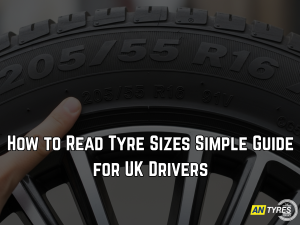
You walk up to your car, look at the side of the tyre, and see a string like
205/55 R16 91V.
It looks like code. But once you understand how to read tyre sizes, that code becomes useful information about grip, comfort, safety, and even MOT rules.
This guide is written for UK drivers. It explains tyre sizes step by step, breaks down the tyre numbers on the sidewall, and provides a tyre code guide you can use whenever you buy or check tyres.
What Those Tyre Numbers Actually Do For You
Here is the thing. Those numbers are not there for decoration. They tell you
- How wide is the tyre?
- How tall is the sidewall?
- What wheel does it fit
- How much weight can it carry
- What speed is it built to handle
Once you learn how to read tyre size on one example, every other size follows the same pattern. So we will stick with a standard size for UK cars
205/55 R16 91V
and use that as the base for this whole tyre code guide.
Tyre Size Explained With 205/55 R16
The first part, 205/55 R16, tells you about physical size and construction.
205 Width in millimetres
The 205 is the tyre width in millimetres from sidewall to sidewall. A tyre marked 205 is roughly 205 mm wide where it sits on the rim.
Wider tyres generally give a larger contact patch on the road, which can mean more grip, especially in the dry, but sometimes more noise and slightly higher fuel use. Narrower tyres can cut through standing water and snow more effectively, improving efficiency.
So the first part of the tyre number’s meaning concerns how much rubber actually touches the road.
55 Aspect ratio or profile
The 55 is the aspect ratio. This is where many drivers get confused because it is not a direct size. It is a percentage.
In this case, the sidewall height is 55 percent of 205 mm.
Lower aspect ratios, such as 40 or 45, mean shorter sidewalls. The tyre looks sportier, the steering can feel sharper, but the ride is firmer, and you feel potholes more.
Higher aspect ratios, such as 60 or 65, mean taller sidewalls. The car often rides more comfortably but can feel softer in corners.
So when you see 55 in 205/55 R16, that number is a simple comfort versus sharpness dial.
R Radial construction
The R stands for radial. Almost every modern car tyre in the UK is a radial tyre, so you will nearly always see R here. Older cross ply designs are rare on modern road cars.
16 Rim diameter in inches
The 16 is the wheel or rim size in inches.
A 16-inch tyre fits a 16-inch wheel. It will not safely fit a 15-inch or 17-inch wheel.
So the second big lesson in reading tyre sizes is that the rim diameter must match exactly.
Load Index and Speed Rating 91V
The next part, 91V, is called the service description. It is easy to skip, but it is where much of the safety lies.
91 Load index
The 91 is the load index. This is a code that links to a table of actual kilograms. For example, 91 usually means the tyre can carry 615 kg at the correct pressure.
You do not need to memorise the whole table. The rule that matters is simple
Match or go above the load index your handbook or door sticker specifies.
The axle weight plates on the car and MOT guidance both expect the tyre load index to be suitable for the weight that the axle can carry. If you fit a lower load rating than the car was designed for, you are eating into your safety margin and could run into trouble with heavy loads.
V Speed rating
The V is the speed rating. It tells you the maximum speed the tyre is designed to handle when carrying its rated load during test conditions.
For everyday UK cars, you might see
T on some smaller cars
H on family hatchbacks and saloons
V, W or Y on faster or higher performance models
Each letter links to a specific speed, but you do not need to learn them all. The useful rule of thumb is
Match the manufacturer’s recommended speed rating, or go higher if you need to.
Going below the specified level is rarely a good idea. It may be allowed in some winter setups with clear labelling in the cabin, but for everyday use, it is better to stay with the original rating or higher.
At this point, you already have most of the tyre size explained.
- 205 width
- 55 aspect ratio
- R radial construction
- 16 wheel size
- 91 load index
- V speed rating
That is the core of the meaning of tyre numbers.
Extra Markings You Should Notice
The sidewall carries more than just the basic size. Different sets of letters and symbols tell you how strong the tyre is, what weather it is suited to, and how it must be fitted.
XL Extra Load and Reinforced
If you see XL, Extra Load or Reinforced on the tyre, it is designed to carry higher loads at higher pressures than a standard tyre of that size.
You will see these a lot on SUVs, vans and seven-seat cars. If your vehicle came from the factory with XL tyres, you should stick with XL replacements. Dropping down to a standard load version can leave less safety margin when the car is fully loaded.
Runflat technology
Some tyres are built as runflats. They can support the car for a short distance at a limited speed even when the air has gone due to a puncture. Brands use different names and short codes for this, but the idea is the same.
If your car was designed to use runflat tyres and has no spare wheel, you should not swap to standard tyres without proper advice. Mixing run-flat and non-run-flat tyres on the same axle is generally not recommended.
M S and the Three Peak Mountain Snowflake
You may see M S on the sidewall. This stands for mud and snow. It usually indicates a tread pattern designed for better traction in mud and light snow than a basic summer pattern. It is often self-declared by the manufacturer.
The Three Peak Mountain Snowflake symbol is different. It is a small mountain with a snowflake inside. This symbol shows the tyre has passed standardised snow performance tests and is legally recognised across Europe as a proper winter tyre.
So for UK drivers planning trips to the Alps or countries with winter tyre laws, the Three Peak Mountain Snowflake symbol is the one that really matters.
E mark and approval codes
Most tyres sold for road use in the UK and Europe carry an E mark. This means the tyre has met European type-approval standards for factors such as strength and performance.
You will usually see a capital E inside a circle or rectangle followed by a number. Every day buyers do not need to decode this number. It simply tells you the tyre has passed the required tests.
Direction, Inside Outside and Rotation
Learning how to read tyre size is only half the job. The tyre also needs to be fitted the right way round to work as designed.
There are three main tread layout types.
Symmetrical patterns. The same across the tread, no specific inside or outside, can be fitted either way, as long as the size and rating are correct.
Directional patterns. There will be an arrow, and usually the word rotation. This shows which way the tyre should turn as the car moves forward. If you fit directional tyres backwards, water is not cleared correctly, increasing the risk of aquaplaning.
Asymmetric patterns. These are marked with words like ‘inside’ and ‘outside’. The tyre can turn either way, but the correct side has to face outwards. The outside shoulder is usually tuned for cornering, while the inside shoulder is tuned for water clearance.
So, a simple rule for your personal tyre code guide is this. After reading the size, always look for arrows and inside or outside markings before a tyre is fitted.
Reading the DOT Code and Tyre Age
Beyond the main tyre size explained so far, another code really matters for safety. The date code.
On the sidewall, you will find a string of letters and numbers starting with DOT or similar. At the end, there will be four digits. These four digits show the week and year the tyre was made.
For example
2321 means week 23 of 2021
5019 means week 50 of 2019
Tyres with three-digit codes are older than 2000 and should no longer be in service.
In the UK, for heavy vehicles, buses, and minibuses, there are now laws that ban tyres older than 10 years on certain axles. For cars and light vans, there is no specific ten-year law yet, but government and tyre safety bodies broadly say that tyres should be inspected closely from five years old and replaced at around ten years, even if the tread is still legal. Rubber hardens and cracks with age, reducing grip and leading to failures.
So when you are learning how to read tyre sizes, add age to the checklist. Do not look at the tread alone. An old, hard tyre with enough tread can still be a bad tyre.
Legal Basics in the UK Around Tyre Sizes
Understanding tyre numbers meaning is not just about shopping. It links directly to MOT tests and road law.
Tyres must be an appropriate size and construction for the vehicle. That includes a suitable load index for the plated axle weight and a speed rating that is adequate for road speeds. Fitting tyres with obviously inadequate ratings can cause MOT problems and is unsafe.
Tyres on the same axle should be of the same nominal size and type. Mixing wildly different sizes or constructions on one axle can upset handling and may be considered dangerous.
Tread depth must be at least 1.6 mm across the central three quarters of the tread around the full circumference. Tyres must also be free from deep cuts, bulges, exposed cords or severe damage. A high number of MOT failures in the UK each year are due to tyre issues alone.
So knowing how to read tyre size and related codes helps you stay out of trouble at MOT time and keeps you on the right side of tyre law.
Simple Checklist For Choosing New Tyres in the UK
You now have the tyre size explained in detail. Here is how to use it in real life when buying replacements.
First, look at the sticker in your door frame or fuel flap and note the recommended size, load index and speed rating for front and rear.
Second, read the size on your current tyres and check that it matches the handbook if it does not, use the handbook or sticker as your reference, not what is currently fitted.
Third, when you choose new tyres, make sure they match the width, aspect ratio, rim diameter and construction, and that they match or exceed the original load index and speed rating. If your car was supplied with XL or run-flat tyres, keep the same type unless a professional confirms a change is safe and sensible.
Fourth, check the date code. Avoid very old stock, and be cautious of tyres approaching 10 years of age, even if they have legal tread.
Do that, and you are no longer guessing. You are using a simple personal tyre code guide tailored to your own car.
Final Words
The strange-looking code on your tyre sidewall is just a compact description of width, profile, construction, wheel size, load-carrying ability, speed capability, design features, and age.
Once you know how to read tyre size, see the tyre size explained in context and understand the tyre numbers meaning from width right through to DOT date, choosing safe and suitable tyres for UK roads becomes much easier.